Infrastructure operations, run by AI
PYXIS3 is the autonomous AI that runs your cloud and data-center infrastructure. It connects to your accounts and the resources inside them, acts within your guardrails to keep the estate clean, right-sized, resilient, secure, and under control, for one predictable subscription priced on the infrastructure it manages.
Already a customer?
Sign in to your workspace
Enter your workspace address to continue.
Don't have a workspace yet? Book a demo
By continuing, you agree to the Terms and Privacy.
One operator for every platform you run
 AWS
AWS Google Cloud
 Azure
Azure
 Nutanix+ On-prem
How it works
It accesses the resources, then operates them
You set the strategy and the limits. PYXIS3 connects to your accounts, models every resource, then runs the loop below on its own across cost, capacity, reliability, security, and governance, grounded in the FinOps Framework and the Well-Architected pillars, and shows its work at every step.
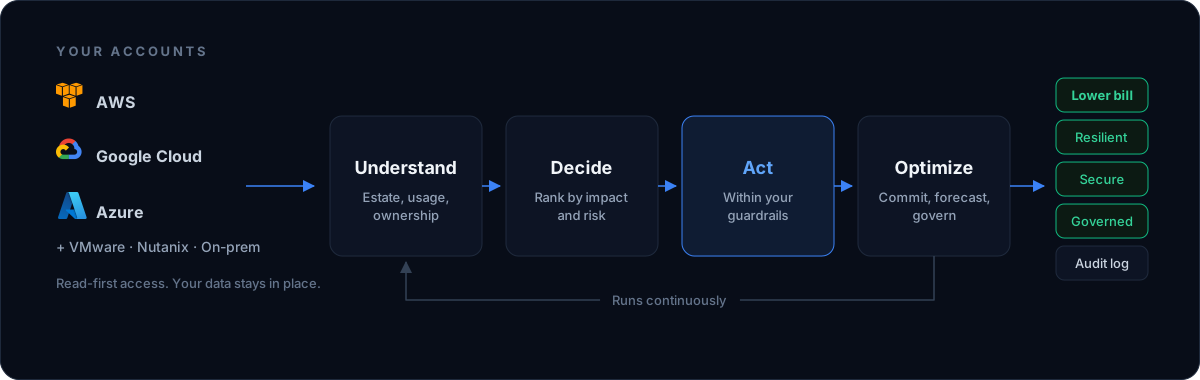
A live map of every resource
Connects to your accounts and inventories every instance, disk, snapshot, IP, load balancer, database, and reservation, with its usage, tags, and owner.
Anomalies caught at the resource
A learned baseline flags a deviation the moment it starts and traces it to the exact resource behind it.
Decisions ranked by impact and risk
A plan ordered by impact and risk across cost, capacity, reliability, security, and governance, so the highest-value, lowest-risk change runs first.
Direct action on the resource
It retires, schedules, rightsizes, reinforces, hardens, and enforces policy on the resources directly, inside your guardrails, then verifies each change. No change windows, no manual work.
Operation around the clock
Continuous rightsizing, scheduling, and cleanup, plus reinforcing workloads running hot, closing exposures, and enforcing policy, never a one-off sprint.
Commitments at the right coverage
Savings plans and reserved capacity sized and maintained against your steady baseline.
Budgets that hold
Forecasts ahead of the invoice, with policy enforced before an overrun lands, not explained after it.
A reason for every move
Each decision and action is logged, attributed, and explained in plain language. Fully auditable.
In practice
What it does across your whole estate
Concrete, repeatable operations across cost, capacity, reliability, security, and governance, grouped by what they touch. Each keeps the estate right-sized, resilient, secure, and in policy; a lower bill is the outcome PYXIS3 is measured on.
Over-provisioned compute, rightsized
Instances and VMs running far below their allocation are moved to a smaller, cheaper size that still clears their real peak, with the headroom you define. The workload keeps running; the bill drops.
Non-production, scheduled off outside hours
Dev, test, and staging are stopped on nights and weekends and brought back before the team logs on. Idle hours nobody uses simply stop being billed.
Idle and zombie instances, retired
Stopped-but-billed, forgotten, and zero-traffic instances are confirmed truly unused, then removed across every account and region, and reversed on request.
Block and object storage, tiered and cleaned
Cold objects move to lower-cost tiers, unattached volumes and aged snapshots are cleared, and lifecycle gaps are closed, so you stop paying hot-tier rates for data nobody reads.
Idle networking and egress, cut
Unused load balancers, unattached IP addresses, and idle NAT gateways are removed, and avoidable cross-zone and egress paths are flagged, so traffic you do not need stops carrying a charge.
Managed databases, rightsized and pruned
Over-sized managed database and cache instances are resized to their real load, idle clusters are paused, and stale read replicas, snapshots, and backups are cleaned up.
Kubernetes capacity, packed to real demand
Under-utilized node groups are consolidated and rightsized to actual pod demand, and idle namespaces and abandoned workloads are surfaced, so clusters stop running capacity nothing schedules onto.
Serverless and functions, right-tuned
Over-allocated function memory and timeouts are tuned to real execution, idle provisioned concurrency is released, and chatty API gateway and event paths are flagged, so pay-per-call stops carrying pay-for-nothing.
Data warehouses and pipelines, optimized
Warehouses are set to auto-suspend when idle, over-sized clusters are scaled to real query load, and abandoned datasets and redundant pipeline runs are cleared, so analytics stops billing for compute nobody queried.
AI, ML, and GPU spend, kept in check
Idle notebooks and training jobs are stopped, GPU instances are matched to the model that needs them, idle inference endpoints are scaled to zero, and token and API usage is attributed, so AI cost tracks the work, not the reservation.
Commitments, sized to your real baseline
Savings plans, reserved instances, and committed-use discounts are bought and maintained to the steady, always-on portion of your usage, then adjusted as that baseline shifts, so coverage stays high without locking in waste.
Anomalies, detected, diagnosed, remediated
A learned baseline catches an unexpected cost spike the moment it starts, traces it to the resource and change behind it, then remediates or escalates with the root cause attached, before it reaches the invoice.
Budgets, forecast and enforced
Spend is forecast ahead of the invoice and held to the policy you set, so an overrun is caught and acted on while there is still a month left to change it, not after the bill arrives.
Every dollar, allocated to its owner
Untagged and shared spend is attributed to the team, service, and environment that drove it, so showback and chargeback are accurate and each owner answers for their own cost.
Saturation risk, caught before it pages someone
A learned baseline watches steady production workloads as they approach their CPU, memory, and throughput limits, and flags rising saturation before it turns into a slowdown or an outage, with the resource and the trend attached.
Capacity headroom, kept right
Over-provisioned headroom is tracked across the fleet so a workload is never starved and never bloated: it is rightsized down when it sits idle and given room as its baseline climbs, so capacity tracks real demand rather than a guess.
Exposures, closed before they are found
Resources reachable from the internet, an open security group, a public path left on, are flagged the moment the exposure appears and restricted to the addresses that need them, before the opening is found from outside.
Policy drift, brought back to standard
Resources with no owner, no allocation tag, or outside the standard are surfaced as they drift and brought back into policy and attributed to a team, so governance holds as the estate grows instead of eroding quietly.
Coverage across every remaining category
Operations across cost, capacity, reliability, security, and governance apply to every layer of your estate, across public cloud, data center, SaaS, and licensing. It also watches, hardens, governs, and optimizes every other category below.
Security & control
Full access, under your control
PYXIS3 takes the access it needs to operate your estate, scoped to the resources and limits you set. It earns that trust with control, not by staying read-only: every autonomous change clears the same guardrails before it runs, and any of them can be undone.
It re-checks before it acts
Immediately before every change, PYXIS3 re-verifies the resource against the baseline learned from your own usage, and holds anything that no longer looks safe.
Capped blast radius
A per-pass limit on how many changes run at once, and a per-change spending ceiling above which everything routes to you for approval.
Change-freeze windows
Set hours when no autonomous change runs at all, for business hours, peak traffic, or a release freeze. The agent simply waits.
One-click rollback
Every reversible change is captured with the state to undo it. Reverse any one from the change ledger and the saving unwinds with it.
Dry run first
Preview the exact next pass before it happens: what it would change, what it would save, and what it is holding back, with nothing executed.
Owner-only autonomy
Only a workspace owner can enable autonomous mode or widen its scope. Everyone else sees the guardrails and history, read-only.
Full audit trail
Every action is logged, attributed, and explained, before and after, so no change happens that you cannot see, trace, or reverse.
Scoped and encrypted
Least-privilege access to only the accounts you connect, revocable at any time, with all data encrypted in transit and nothing leaving where it lives.
Reversible, lower-risk changes run inside these limits. Higher-impact moves, such as multi-year commitments, are always prepared, costed, and sent to you for approval. You decide where that line sits, and nothing crosses it without your authorization.
Integrations
Connects to your stack
PYXIS3 operates inside the tools you already run. It connects to your clouds and data centers directly, signs in through your identity provider, and routes its work to where your team already works.
Clouds & data centers
LiveIdentity & SSO
LiveProvisioning
LiveNotifications & approvals
Rolling outTickets & change
Rolling outObservability
Rolling outCloud and data-center connectors, identity, and provisioning are live today. Notification, ticketing, and observability routing roll out by plan; tell us what your team runs and we will prioritize it.
Pricing
One subscription to operate your whole estate
One predictable subscription, priced on the cloud spend PYXIS3 manages, the way cloud platforms charge. Every dimension is included, the engine is never gated, and it typically saves many times what it costs. Start self-serve on Connect, then add organization-wide governance, SSO, and support as you scale.
Connect
Self-serveOne subscription to operate your whole estate, priced on the cloud spend PYXIS3 manages, billed monthly. The full engine and every dimension, included. See your plan and projected savings before you pay.
- The full autonomous operations engine
- All five dimensions, nothing gated
- Unlimited accounts, regions, and resources
- Autopilot within your guardrails
- Full audit trail of every action
- Community support
Operate
For organizations at scaleA lower negotiated rate on the spend under management, with the governance, SSO, and support a large organization needs. Set with sales.
- Everything in Connect
- A lower rate, negotiated for scale
- SSO and role-based guardrails
- Organization-wide governance and allocation
- Unlimited workspaces and teams
- Priority support
Enterprise
Regulated and large estatesA custom rate and terms, with a dedicated instance, data residency, and SLAs, set in your agreement.
- Everything in Operate
- Dedicated instance
- Data residency
- Security review and SLAs
- Custom integrations
- Named support
How the subscription works
- 1
Connect and see your plan
Grant a read-first role and add your accounts. PYXIS3 maps every resource and shows you what it would operate and the savings it projects, before you pay anything.
- 2
It operates your whole estate
Inside your guardrails, PYXIS3 runs all five dimensions continuously: it removes waste, right-sizes, reinforces reliability, hardens security, and enforces governance, and tracks every change.
- 3
You pay one predictable subscription
A small percentage of the cloud spend it manages, billed monthly, with every dimension included. It typically saves many times what it costs.
A worked example
Say PYXIS3 manages $55,000 of cloud spend across your accounts, and realizes $11,000 in savings this month.
On Connect the subscription is 2% of the cloud spend PYXIS3 manages, with a $200/mo minimum, billed monthly and including every dimension. It is not a share of your savings and not a number you can shrink by saving less. Operate and Enterprise use a lower negotiated rate at scale, set with sales.
The same engine on every plan
Plans differ by scale, governance, and support, never by gating what the AI can do. Every plan runs the full autonomous operations engine from the first connected account.
- Rightsizing across compute, databases, and Kubernetes
- Idle, orphaned, and storage cleanup
- Networking and egress optimization
- Off-hours scheduling for non-production
- Serverless, data, and AI/GPU optimization
- Commitment and rate optimization
- Anomaly detection and remediation
- Budget forecasting and enforcement
- Cost allocation across every team
- Coverage of every layer of your estate
- Unlimited accounts, regions, and resources
- Full audit trail of every action
FAQ
Frequently asked questions
Our approach
Built like an operator, not a dashboard
PYXIS3 is built by people who have run infrastructure at scale and were tired of tools that find the problem and hand it back. A few principles shape every part of it.
It acts, it does not just advise
A dashboard reads your bill and leaves the work to you. PYXIS3 reaches the resource and changes it, within your guardrails. Detection without action is a slower, more expensive report.
Control, not blind trust
Autonomy is only as good as the brakes. Every change is re-checked against its baseline, capped per pass, paused during your freeze windows, logged, and reversible in one click. You stay in control of where the line sits.
Honest by construction
It shows its work on every action and accounts for every dollar. We say plainly what it does not do: it runs the resource and cost layer beneath your CI/CD, security, and incident tooling, not in place of them.
Aligned pricing
One subscription priced on the infrastructure it manages, the way platforms charge, with no lock-in and no percentage of your savings. It is built to save you many times what it costs.
Your data stays put
Least-privilege, scoped access to only the accounts you connect, revocable at any time. Your data stays where it lives; there is no pipeline to build and nothing is exfiltrated.
Every environment, one operator
AWS, Google Cloud, Azure, VMware, Nutanix, and on-prem, run from a single loop. The cost-optimizer crowd stops at the public cloud; the estate does not, and neither does PYXIS3.
Design partners
From the teams running it
Illustrative, from our design-partner workspaces. Want to be one of the first named teams here? Come run it on your estate.
"It stopped being a dashboard we felt guilty about ignoring and started being the thing that actually closed the tickets. The first month it retired more idle than our last quarter of cleanup did."
"The change-freeze window and the dry run were what got it past our SREs. They could see exactly what the agent would do before it did anything, and undo it in one click. That is what made autonomy palatable."
"We run across three clouds and a rack of VMware we cannot move. PYXIS3 is the first thing that operated all of it from one place instead of three tools that each saw a third of the estate."
Book a demo
See it run on your cloud
Pick a time that suits you. We connect read-only to your accounts, map what is there, and walk through what PYXIS3 would operate — and the savings in month one.